<style> /* Reveal x-cloak content so sidebar branch lists and closed-state chips render — EXCEPT the mobile slide-in backdrop, which would otherwise cover the whole viewport in black/40 with no way to dismiss (the dismiss handler is x-on:click="mobileHeader = false" and can't fire without Alpine). */ [x-cloak]:not([x-show="mobileHeader"]) { display: revert !important; } /* (1) Force every version card OPEN so all release-notes content is visible. Overrides the default `.rn-ver-body { grid-template-rows: 0fr }` from release-notes.css, which is normally lifted to `1fr` via Alpine's `:class="{ 'rn-ver-body--open': open }"`. */ .rn-ver-body { grid-template-rows: 1fr !important; } /* (1b) Strip `hidden="until-found"` from collapsed card bodies. WEB-3164 added that attribute on cards 2..N (the first card omits it, see the `{% unless forloop.first %}` in release-notes-cards.eleventy.liquid) so Chrome/Edge browser find-in-page can reveal text inside collapsed bodies and fire a `beforematch` event Alpine catches to pop the card open. Alpine's `x-effect` directive normally removes the attribute when `open` flips true — but without JS that directive never runs, so cards 2..N stay hidden via either `content-visibility: hidden` (Chrome/Edge/Safari 17+ resolve `hidden="until-found"` to that) or `display: none` (older Safari / unknown browsers treat it as a plain boolean `hidden`). Rule (1) above lifts the SCSS-based grid-rows collapse but does NOT override `[hidden]` — the attribute applies a higher-priority `display: none` / `content- visibility: hidden` that wins over grid-template-rows. This rule covers both browser-engine paths: `display: revert` restores the element's normal display (the `grid` utility on the wrapper), `content-visibility: visible` overrides the modern-browser path. */ .rn-ver-body[hidden] { display: revert !important; content-visibility: visible !important; } /* (2) Hide controls that can't do anything without JS so the UI doesn't lie about being interactive: the expand/collapse chevron, the closed-state category chips (Security 3 / Features 5 / …), the section-level expand-all toggle if reintroduced, and the cursor-pointer hint on the header. */ .rn-ver-chevron, .rn-ver-chips, .rn-toggle-all { display: none !important; } .rn-ver-header { cursor: default !important; } /* (3) Hide status pills (Current / Beta / Extended maintenance) and the matching sidebar dots. Pills are rendered server-side from productInfo.json at build time and are accurate at publish — but a stale cached page in Sparkle could surface them on a version that is no longer "Current" by the time the user opens RDM, so hiding them entirely under no-JS removes the whole class of misleading-stale-pill failure modes. */ .rn-ver-tag-line, .rn-status-pill, .rn-status-dot { display: none !important; } /* (4) Sidebar branch chevrons stay frozen in the "closed" rotation without Alpine to flip them — drop them since the branch lists below are already revealed by the x-cloak rule above. */ .rn-toc-branch-head > span:first-child { display: none !important; } /* (5) Hide mobile-only chrome whose Alpine click handlers can't fire: the top mobile menu-open bar and the sidebar's mobile close bar. Both gate `mobileHeader`, which never toggles without JS. */ .rn-main-header, .rn-sidebar > div:first-child { display: none !important; } </style>

Release notes

Release notes

Version 2026.2

Table of contents

Thank you for updating Remote Desktop Manager (RDM) to version 2026.2!

Below, we'll take a quick look at the most exciting updates. For the full list of changes, check out the release notes.


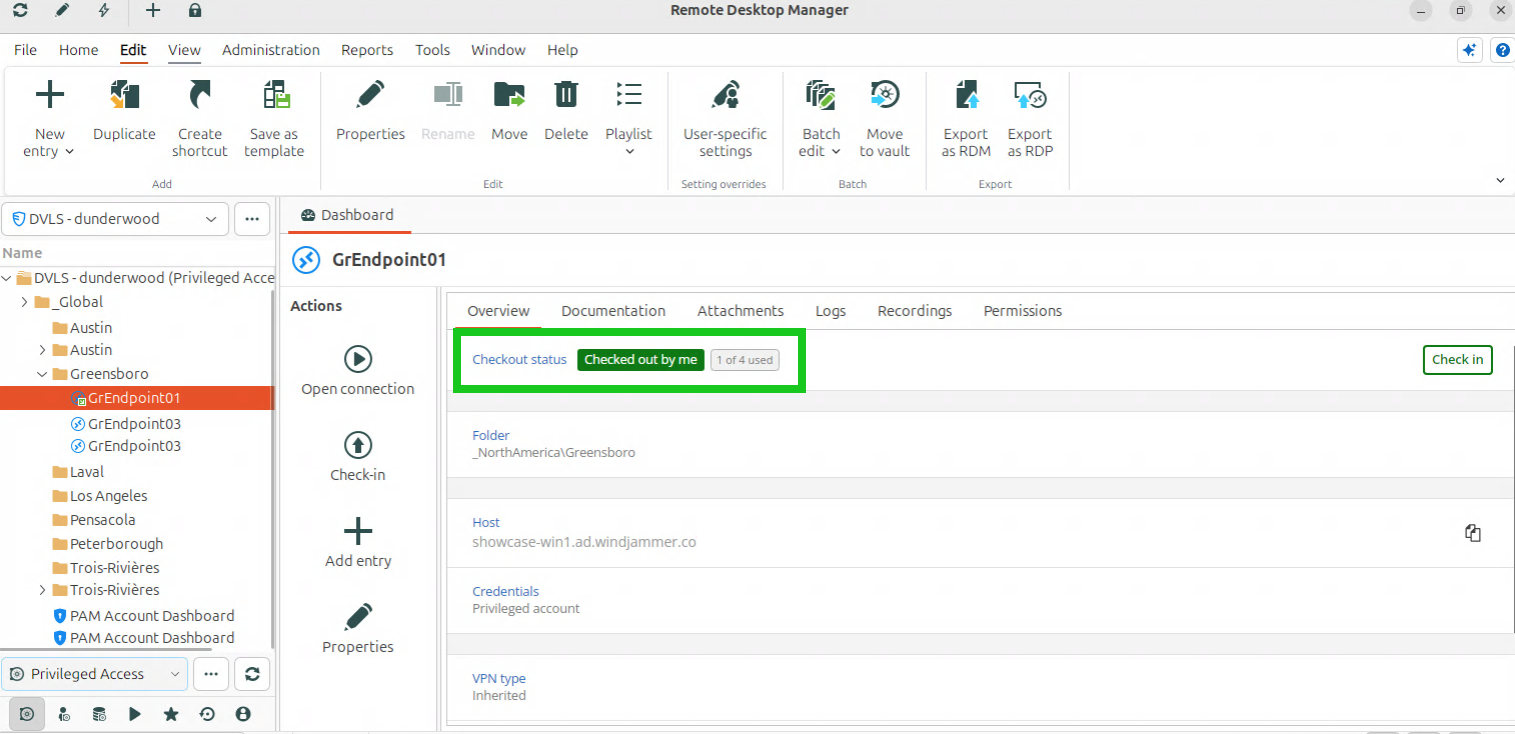
Multi-user checkouts on shared entries

This release expands how shared resources get checked out. Multiple checkouts now allow a single entry to be checked out by a defined number of users simultaneously, useful for pooled devices, service accounts, and other shared infrastructure where one-at-a-time checkout gets in the way.
Administering Devolutions Server from RDM

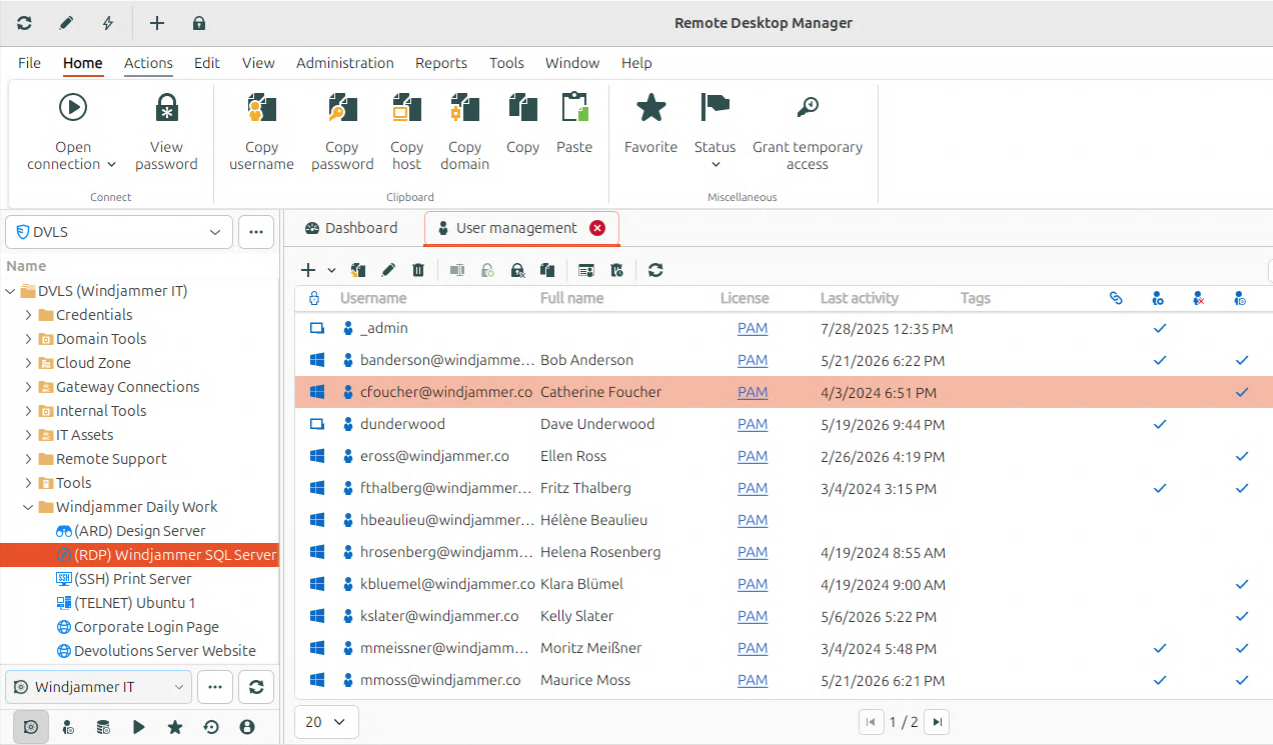
Managing users, user groups, and licenses no longer means leaving Devolutions Remote Desktop Manager (RDM). Administrative interfaces are now embedded as tabs in Devolutions Server, so Server administration occurs in RDM rather than in the web UI.
Full read & write offline mode for Devolutions Cloud

Devolutions Cloud also gains full read and write access in offline mode via RDM, previously read-only. Edit while disconnected and changes sync when you reconnect, bringing Cloud to parity with Server and SQL Server for offline workflows.

Sign in to websites with social login

A new social login credential type is available for website entries. Associate an entry with the federated provider behind it (Google, Microsoft, Apple, GitHub, Amazon, Facebook, X, Discord, or Slack), and when you launch a website that uses social login, RDM detects the available providers and guides you through the sign-in flow.

External vault credentials in more places, plus batch edit for RDP

Credentials stored in other vaults now work across more of RDM for Linux. Store an entry's OTP in a separate vault from its credentials, pick credentials from a different vault when launching with Open with Parameters, and use external vault credentials at the Quick Connect prompt. RDP session-type settings can also be batch edited, so you can update properties across many entries at once instead of opening them one by one.