











 Steven Lafortune
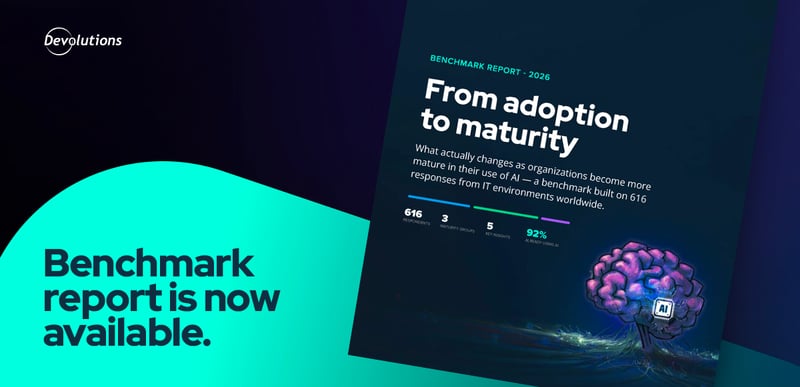
We are delighted to announce that the Devolutions 2026 AI Maturity Benchmark Report is now available.
This is our first global look at what actually changes as organizations become more mature in how they use AI, based on 616 responses from IT environments worldwide.
Click here to get the report right now and dive into the data. Otherwise, keep reading to learn more about the survey and get a summary of key findings.
About the survey
Almost everyone is using AI. Only 8% of organizations in this survey said they are not using it at all. But using AI is not the same as using it well.
To understand what actually changes as organizations mature, our survey explored:
- How organizations are using AI today, and in which parts of the business
- Whether leadership is actively promoting and investing in AI
- Who owns AI initiatives, from informal experiments to dedicated roles
- What gets in the way of scaling and automation
- Whether organizations formally measure the value of AI
- Where they stand with AI agents, from exploration to production
Key findings
The report is loaded with interesting, insightful, and in many cases unexpected revelations. Here are some, but certainly not all, key findings:
-
Only 14% of Early-stage organizations say leadership actively promotes and invests in AI, compared with 91% of Advanced organizations. That is 6.5 times higher at the mature end of the curve. Leadership support is not a nice-to-have; it is the dividing line.
-
50% of Early-stage organizations have no clear AI owner. Among Advanced organizations, 55% have a dedicated AI role or team. As maturity rises, AI stops being a side project and gets a real home inside the organization.
-
Early-stage organizations use AI in about 2 of the 9 areas we tracked. Advanced organizations use it in more than 6. Scaling AI is not about doing more of the same. It is about spreading it across more of the work, and supporting that footprint.
-
Just 0.4% of Early-stage organizations formally track AI benefits with KPIs. Among Advanced organizations, that number is 47%. Many teams already notice the gains. Far fewer measure them. That gap is one of the clearest signs of maturity.
-
About 7 in 10 Early-stage organizations have not moved past exploring AI agents. More than 4 in 5 Advanced organizations are already piloting them or running them in production. Agents are closer than many people think. Caution does not disappear, though: security remains the top concern across every group.
-
Microsoft Copilot and ChatGPT are the most widely used tools, at 60% each. Advanced organizations use twice as many AI tools on average as Early-stage ones. Maturity comes with a broader toolset, and often with tools built or customized in-house.
Recommendations
The report also provides targeted recommendations to help organizations benchmark their progress, spot their blind spots, and move from adoption to maturity.
Importantly, the recommendations featured in the report are practical and do not assume an enterprise-sized AI department, or a finished strategy before you start. You’ll find everything in the report!
Insights from our CEO
We asked our CEO, David, to provide some insights on the report, and discuss what it means for teams trying to get past experimentation. Here is what he shared:
“There’s no final version of this. AI will keep evolving, and so will the way we work with it. What matters is that we keep learning, keep challenging ourselves, and keep finding better ways to use it. We don’t need AI to do everything for us. We need to understand where it can help people do better work, where it can make the organization stronger, and where humans continue to bring the judgment and creativity that make the difference.”
Get the report
Click the banner below to download the report. There is no cost or sign-up required. Your download [PDF] is immediate.
We also invite you to share your feedback by commenting below, or across our social media channels.
