








 David Hervieux
Hello everyone!
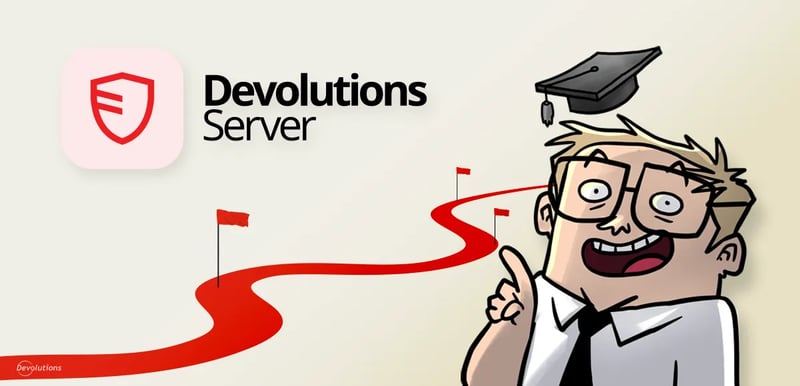
It is my pleasure and privilege to once again reveal our annual roadmap. The Devolutions 2026 roadmap outlines major additions and improvements planned across our product roster, along with projected completion timelines.
To make it easier to explore, the roadmap is structured around the four core solutions we offer: workforce password management, remote access management, remote desktop management & IT operations, and privileged access management. You’re welcome to navigate directly to the sections that interest you most using the table of contents or, if you prefer, read through the entire roadmap for a complete overview.
Workforce password management
Despite the shift toward passwordless authentication, credentials aren’t going anywhere yet. For IT teams, the real challenge is managing the secure, efficient sharing of passwords among employees, contractors, and external users. These additions help you bring order to the chaos and reduce security risks at scale.
- 2026.1: fine-grained permission model. Moving beyond broad admin privileges to a granular rights system in Devolutions Server, with Devolutions Hub changes coming later this year, aligning access control with specific operational roles with role-based access control (RBAC).
- 2026.1: streamlined contractor lifecycles. Dedicated workflows in Hub & Devolutions Server for external users, simplifying provisioning, defining clear access scope, and automating the "onboarding-to-offboarding" chain.
- 2026.1: compact UI mode. A simplified, launcher-style interface starting with Hub focused solely on "launch and go" workflows, reducing complexity for end users who do not require full administrative features.
- 2026.1: Devolutions Hub usability & portability enhancements. Streamlined entry creation via favorites when adding entries, coupled with native .rdm import/export support to ensure seamless transferring of data between local and the cloud.
- Multi-identity provider (IdP) SSO support. Configure multiple IdPs side-by-side in the Hub to support complex organizational structures and distinct tenant scenarios.
- Real-time architecture & push updates. Transitioning Hub (cloud-hosted) & Devolutions Server (self-hosted) web experiences to a SignalR-based architecture for instant data refreshes and improved security responsiveness.
- AI-assisted operations. Integrating an AI assistant into the Devolutions Server web interface to accelerate administrative tasks and search, evolving from the RDM prototype into a production-grade operational aid.
- Writable offline mode for Devolutions Hub. Enable editing and working with cloud-hosted Devolutions Hub data even without an internet connection, with changes syncing automatically when reconnected.
Remote access management
Traditional VPNs don’t meet the precise, controlled access IT professionals demand. You need to grant access to exactly the right server or protocol, not your whole network. Our approach gives you the control and security you expect, no unnecessary exposure, just efficient, targeted access.
- 2026.1: contractor-specific remote access. Pairing the compact UI with restricted access patterns to provide third parties with secure, isolated entry points without exposing the broader management surface.
- Optimized jump host routing. Enhancements to "jump" workflows to streamline connectivity through segmented networks, making multi-hop access easier to configure and operationalize.
- Protocol modernization (IronVNC / IronRDP). Continued implementation of a modernized, Rust-based remote protocol stack to enhance session reliability, reduce latency, and improve security posture over variable network conditions.
- Devolutions Send enhancements, including improved secure sharing workflows with active link history, read receipts, and deeper browser extension integration for seamless secret sharing.
Remote desktop management & IT operations
IT professionals rely on Remote Desktop Manager (RDM) as the central hub for daily operations. We keep everything in one place, minimizing context switching and letting you focus on what matters: fast troubleshooting, efficient management, and less wasted effort. RDM Free users can now move beyond local SQLite files to a fully managed backend, with access to a complimentary 1-user license for Devolutions Server or Devolutions Hub.
- 2026.1: embedded PowerShell Universal web dashboard. Integration of PowerShell Universal (PSU) web dashboard within RDM, allowing operators to trigger automation and view dashboards without context-switching.
- 2026.1: integrated vault administration. Further capabilities to manage Hub & Devolutions Server vaults directly from the RDM desktop client, reducing the need to toggle between desktop and web portals for configuration changes.
- 2026.1: Hub Personal local backup. Enhanced data protection for individual users, allowing Hub Personal data sources to be backed up locally to ensure offline redundancy and independent recovery options.
- 2026.1: Updating tooling. Native support for JWT and PGP credential types, complete with a built-in JWT decoder, to streamline the management of authentication tokens and encryption keys for cloud-native workflows.
- 2026.1: LastPass & 1Password SSO support. Compatibility with single sign-on (SSO) authentication flows for LastPass and 1Password integrations, ensuring seamless and compliant access for users with federated identities.
- 2026.1: Initial RDM Jump to Devolutions Agent transition. The Rust-based Devolutions Agent is an always-on service and a modern successor to RDM Jump. The 2026.1 release delivers 1:1 feature parity and coexistence, allowing teams to transition to this more robust architecture without operational disruption.
- Unified remote support (ControlR). Deeper integration of remote helpdesk workflows, allowing operators to initiate and manage support sessions from the same console used for infrastructure management.
- Protocol modernization through IronVNC & IronRDP: A long-term strategic shift to our own Rust-based protocol stacks to improve security, reliability, and cross-platform consistency. Expect a best-in-class IronVNC implementation to replace legacy components in early 2026, followed by IronRDP later in the year, operating alongside standard RDP as capabilities mature.
- High-fidelity session recording. Overhaul of the session recording engine and local player to support resolution changes, proper resizing, and smoother playback for rigorous audit and post-incident reviews.
- Migration to the .NET 10 framework. Adopting the newer runtime for long-term maintainability and platform modernization, which will require an updated runtime install on workstations.
An aside on the future of Devolutions with Avalonia
We are also securing RDM’s future by partnering with the Avalonia UI framework to deliver native performance across every platform. With Avalonia, we can develop a single user interface and share it seamlessly across all apps, resulting in a more stable, bug-free experience.
Privileged access management
IT professionals know privileged account protection is non-negotiable. But security shouldn’t slow you down. Our solution combines strong vaulting with seamless workflows, so credentials stay locked down, but always ready when you need them.
- 2026.1: proxy-based credential injection. Inject credentials into sessions via the Devolutions Gateway proxy, ensuring secrets are never revealed to the client machine or user, eliminating the risk of clipboard scraping or manual exposure.
- 2026.1: universal PAM credential usage. Decoupling PAM credentials from specific entry types, allowing managed secrets to be injected into a broader range of RDM connection types.
- 2026.1: privileged account tiering. Ability to automatically classify and group privileged accounts by tier based on your unique environment, improving governance reporting and risk assessment.
- 2026.1: high availability for PAM services in Devolutions Hub. Architectural improvements to ensure resilience and uptime for critical PAM components, particularly in high-demand Hub deployment scenarios.
- JIT conditional access. Enhanced policy enforcement at check-out, including MFA check, to ensure privileged credentials are only released when strict security criteria are met.
- Entitlement discovery & reporting (CIEM). A deployable discovery module, powered by PowerShell Universal, to scan infrastructure, map entitlements, and generate actionable visibility reports on standing access.
- Endpoint privilege controls (PEDM). Early implementation of endpoint privilege management via Devolutions Agent to remove standing admin rights and enforce least-privilege elevation rules on endpoints.
- Expanded PAM provider ecosystem. Broadening integration support to include native rotation and management for additional providers, including MongoDB (2026.1.x) and Google Cloud IAM.
- Vault architecture convergence. Strategic move toward merging standard vaulting and PAM vaulting capabilities, allowing teams to mix standard and privileged workflows without artificial storage silos.
Lowering the barrier to building with PowerShell Universal
Expanding on the free tools that have received updates or additions, we’re introducing the PowerShell Universal Developer edition, a no-cost license that unlocks the complete PowerShell Universal feature set for local development.
This edition is designed for developers who want to build, test, and validate PowerShell Universal applications on their own machines, using the same capabilities they’ll eventually run in production, without needing to purchase a server license just to get started.
The Developer edition provides access to everything PowerShell Universal offers, with no feature limitations.
- Custom web apps & dashboards: Rapidly build interactive tools and visualizations using integrated UI frameworks and components.
- Automation & integration: Host scripts and modules to execute scheduled jobs or expose logic via REST APIs.
- Security & governance: Secure access to all resources using supported authentication providers and fine-grained role-based access control (RBAC).
You can explore the full feature list here and learn more about the developer edition in this blog post!
We’re just getting started!
As you can see, we have many exciting developments planned for the months ahead. But if you think that this is all that we have prepared, think again! We call this outline a “roadmap” because it is a high-level overview of major milestones and objectives. It is definitely not meant to be an exhaustive list of the additions, enhancements, and adjustments that we’re developing.
To help ensure that we continue serving your needs, solving your problems, and supporting your success, please tell us about your experience with our products: what you like and want us to enhance, and what you want us to change, re-invent, or remove.
The best way to get in touch is to post in our forum, where you can chat directly with our experts (and don’t be surprised if you get a response from other members or me, a member of the leadership team, within minutes of posting!).
Thank you! The best is yet to come
This roadmap reflects where we’re focusing our energy in 2026: practical improvements, stronger foundations, and clearer workflows across security, access, and daily IT operations. It’s a view into our priorities, not a promise of everything we’re building, but the work we believe will have the most impact for teams using Devolutions every day.
As always, this direction is shaped by how our products are used in the real world. Your feedback helps us validate what’s working, refine what isn’t, and adjust where it matters most. If you have thoughts, questions, or ideas, our forum remains the best place to share them and engage directly with our team.
Thank you for taking the time to explore the 2026 roadmap and for continuing to build with us. We’re looking forward to the year ahead.
 Steven Lafortune
 Marc-Andre Moreau