











 Marc-Olivier Cantin
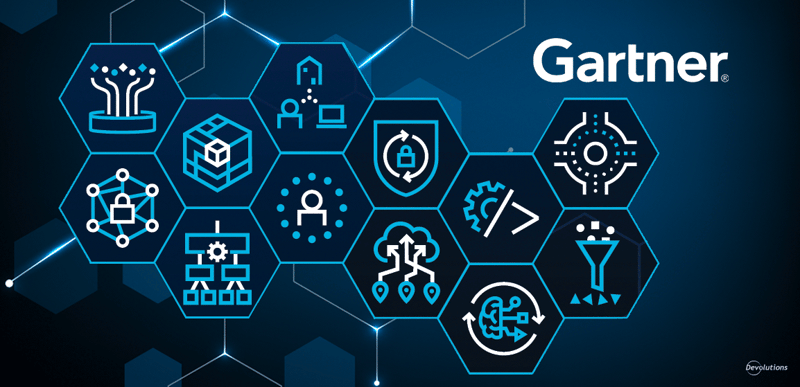
Gartner has revealed its top 12 strategic technology trends for 2022. This year’s roster of trends is rooted in three core themes:
- ENGINEERING TRUST: Establishing trusted digital connections for people and devices everywhere.
- SCULPTING CHANGE: Solutions to rapidly scale digital creativity, anywhere.
- ACCELERATING GROWTH: Innovative capabilities to accelerate business growth beyond today.
As noted by Gartner VP David Groombridge: “From COVID-19 to political unrest to climate change, organizations are constantly buffeted by unexpected events. But the promise of digital business as a way to thrive and outperform the competition during these disruptions remains clear.”
Below are the top 12 strategic technology trends for 2022. Please note that these are listed in the order they appear in the Gartner report, and not necessarily in order of impact or priority:
1.,Data Fabric
Data fabric is an architecture and set of data services that integrates data across platforms and users, in order to make data available wherever it is needed across cloud, on-premises, and edge devices. The goal is to enable organizations to deploy infrastructure solutions that align with their requirements, but without triggering risks and limitations regarding data service levels, access, and security. To get started with data fabric, Gartner advises organizations to:
- Use metadata analytics to determine current data utilization patterns for ongoing business operations.
- Identify priority areas to introduce data fabric solutions.
- Prioritize areas with significant drift between actual and modeled data.
2.,Cybersecurity Mesh
Cybersecurity mesh is a distributed architectural approach to dependable, adaptable, and scalable cybersecurity control. This enables authorized users to securely access any digital asset from anywhere. Interest in cybersecurity mesh surged during the pandemic, as many users and assets were temporarily or permanently located outside conventional physical security parameters. It is predicted that within two years, organizations that adopt a cybersecurity mesh architecture will reduce the financial impact of individual security incidents by an average of 90 percent. To get started with cybersecurity mesh, Gartner advises organizations to:
- Prioritize composability when selecting security solutions.
- Prioritize interoperability when selecting security solutions.
- Build a common base framework to compose and integrate security solutions.
3.,Privacy-Enhancing Computation
Essentially, privacy-enhancing computation (PEC) enables different entities to extract value from data without exposing themselves or their other datasets. Various techniques that drive PEC include zero-knowledge proofs, secure multi-party computation, differential privacy, and homomorphic encryption (although currently full homomorphic encryption is not rapid enough for most business implementations). It is estimated that within three years, 60 percent of large organizations will utilize one or more PEC techniques in analytics, business intelligence, or cloud computing. To get started with PEC, Gartner advises organizations to:
- Investigate PEC use cases to use personal data in untrusted environments.
- Investigate PEC use cases for analytics and business intelligence purposes (internally and externally).
- Prioritize investments in applicable PEC techniques to gain an early competitive advantage.
4.,Cloud-Native Platforms
Cloud-native platforms leverage the elasticity and scalability of cloud computing, in order to accelerate time-to-value. It is predicted that within three years, cloud-native platforms will provide the foundation for more than 95 percent of new digital initiatives. To get started with cloud-native platforms, Gartner advises organizations to:
- Minimize basic lift-and-shift migrations that fail to take full advantage of cloud attributes.
- Focus on ways to invest in cloud-native platforms.
- Adopt modern principles of application architecture.
5.,Composable Applications
Composable applications are packaged-business capabilities (PBCs) or software-defined business objects. This approach towards technology architecture supports fast, safe, and efficient application change. To get started with composable architecture, Gartner advises organizations to:
- Embrace the building blocks and principles of composable business.
- Champion composable architectural principles in all new technology initiatives, including application modernization, new engineering, and the selection of new vendor services.
- Buy standard PBCs on application marketplaces.
6.,Decision Intelligence
Decision intelligence establishes a framework that enables fusion teams to manage, evaluate, and improve decisions based on insights and feedback — ultimately enhancing organizational decision-making. At the consumer/retail level, examples of decision intelligence include recommendation engines that leverage AI and ML to predict what products customers would find most suitable, or what movies they would enjoy watching next. To get started with decision intelligence, Gartner advises organizations to:
- Explore how to use decision intelligence in areas where business-critical decision-making must be improved with more data-driven support or AI-powered augmentation.
- Explore how to use decision intelligence where decisions can be scaled and accelerated with automation.
- Explore how to use decision intelligence to analyze competitor strategies and evaluate historic decisions.
7.,Hyperautomation
Hyperautomation utilizes AI, ML, robotic process automation, and event-driven software to automate as many IT and business processes as possible. Interest in hyperautomation has dramatically increased in the last two years; during the pandemic, many more organizations sought to enable and enhance remote, digital-first options. To get started with hyperautomation, Gartner advises organizations to:
- Standardize and consolidate systems and processes across the enterprise, with a focus on improving efficiency, quality, and agility.
- Maximize the use of remote monitoring and control systems.
- Leverage AI, ML, and real-time analytics to enable partial or full automation of complex systems.
8.,AI Engineering
AI engineering focuses on operationalizing updates to AI models through integrated data and model and development pipelines, in order to deliver consistent business value from AI. This approach, which combines automated update pipelines with strong AI governance, is seen as the bridge that enables AI projects to move beyond the proof-of-concept and prototype stage, and into full-scale production. To get started with AI engineering, Gartner advises organizations to:
- Avoid the common mistake of focusing on defining an AI strategy and platforms, rather than on business problems and organizational issues.
- Implement AI engineering as a strategic differentiator for creating and maintaining production AI value.
- Establish and refine AI engineering practices that incorporate best practices from DataOps,
- ModelOps, and DevOps.
9.,Distributed Enterprise
Distributed enterprise is a virtual-first, remote-first architectural approach designed to digitize consumer touchpoints and build out experiences to support products. Interest in distributed enterprise skyrocketed during the pandemic, as both employees and consumers were unable to access traditional, physical avenues (e.g., corporate offices, stores). To get started with distributed enterprise, Gartner advises organizations to:
- Plan to pivot business models to capture market share from customer and consumer changes due to remote working.
- Adopt “virtual first, remote first” architectural principles.
- Provide the tools for fusion teams to rapidly develop and improve customer-facing technologies.
10.,Total Experience
Total experience (TX) integrates four concepts: customer experience, user experience, employee experience, and multiexperience (i.e., the various permutations of modalities, devices, and apps that users interact with on their digital journey across the various touchpoints). The goal is to interconnect and enhance each of these for a more holistic overall experience for consumers, employees, and all other stakeholders. To get started with TX, Gartner advises organizations to:
- Generate buy-in and enthusiasm around TX as a way to achieve differentiation via capitalizing on new experiential disruptors.
- Instruct teams pursuing experience improvement initiatives to partner with and learn from others.
- Make all leaders of experience-related initiatives equally responsible for solving the combined needs of customers and employees.
11.,Autonomic Systems
Autonomic systems are self-managing physical or software systems that learn from their environments. However, unlike autonomous or automated systems, autonomic systems have the ability to dynamically modify their own algorithms without software updates. This allows rapid responses to change, and enables management at scale of complex environments. To get started with autonomic systems, Gartner advises organizations to:
- Pilot autonomic technologies in cases where early adoption will deliver agility and performance benefits in managing complex software or physical systems.
- Be aware of the challenges presented by nondeterminism (the path of execution is not fully determined by the specification of the computation, and therefore the same input can produce different outcomes).
- While the deployment of autonomic systems is currently most apparent in complex security environments, do not overlook the possibility of applications in physical systems like manufacturing machines, smart spaces, drones, and robots.
12.,Generative AI
Generative AI is a type of AI that learns a digital representation of artifacts from sample data, and leverages it to create new, original, and realistic artifacts. The key is that these artifacts retain a striking likeness to the training data, but do not repeat it. This allows generative AI to function as a powerful engine of rapid innovation for enterprises. It is predicted that within three years, generative AI will account for 10 percent of all data produced — up from 1 percent today. To get started with generative AI, Gartner advises organizations to:
- Prepare to deal with deepfakes, and think about how synthetically generated data could accelerate the analytics development cycle, while lowering the cost of data acquisition.
- Select proven uses of generative AI to accelerate the creation of new products, and increase the personalization of artifacts.
- Understand how to use the appropriate governance to exploit generative AI’s transformative potential.
What Are Your Thoughts?
What is your view of Gartner’s top 12 security trends for 2022? Do you think other trends should be included on the list? Is your organization implementing (or planning to implement) any of these technologies or approaches? Please share your thoughts and insights.
 Steven Lafortune

 Marc-Andre Moreau